Early Childhood Education in Brazil: 2026 Outlook
Fewer children, higher demands. We crossed seven public INEP, IBGE and FNDE datasets with AI models to measure the forces that will reshape the sector through 2030.
Get the full study
Fill in your details and we'll e-mail you the PDF.
- Author
- André Mosko
- CTO at OSLO.
- In collaboration with

- Format
- 57 pages · PDF (in Portuguese)
A preview of the study
Six numbers that change the plan.
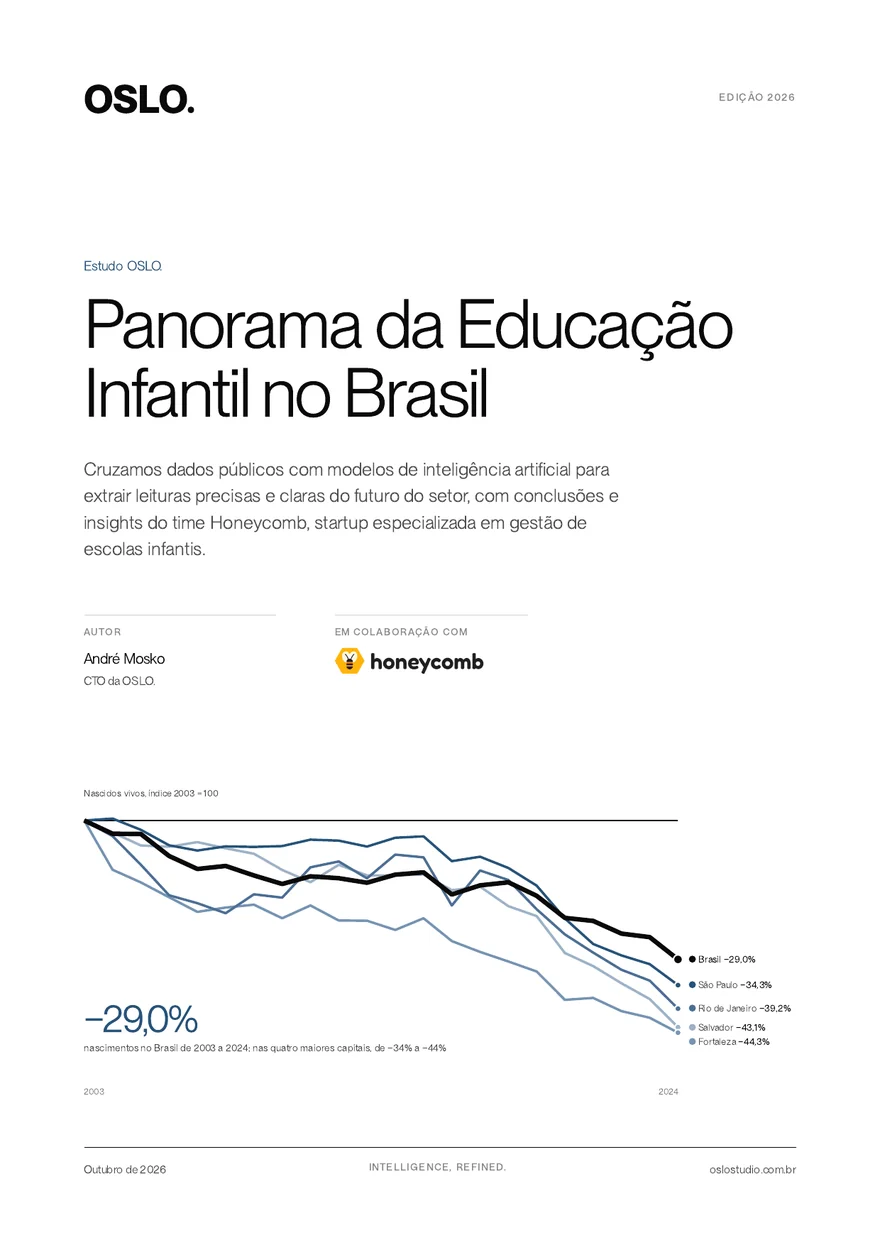
- −29%Birth rate
Brazil recorded 2.42 million births in 2024, the lowest figure since 2003.
- 2025Turning point
Early childhood enrolment stopped growing. In private schools, it fell by 2.5% and 5.9%.
- +961 milPlaces to the target
Extra nursery enrolments needed by 2036 to reach the new national plan's 60% target.
- 10,5%School exits
Schools with up to 50 pupils leave early childhood education at this rate every year.
- −36%Teacher training
Teaching graduates fell from 165,600 in 2021 to 105,400 in 2024.
- ×4Inclusion
The share of special-needs children in early childhood education quadrupled in five years.
Who it's for
Written for decision makers.
- 01
School leaders
To tell structural trends from passing difficulties and plan enrolment, staff and revenue.
- 02
Education, technology and investment
A measure of the market's size and direction, with three tuition scenarios for 2030.
- 03
Policymakers and press
The gap to the new national nursery target, state by state, and what closing it takes.
Contents
11 chapters.
- 01The curve has already turned
- 02The size of the next generation
- 03Who is in school and who is not yet
- 04Inside the private market
- 05Why some schools close
- 06Where demand is and who pays
- 07Three scenarios for 2030
- 08Who will teach
- 09Inclusion: a more diverse classroom
- 10What to do with these numbers
- 11Profiles of eight state capitals